

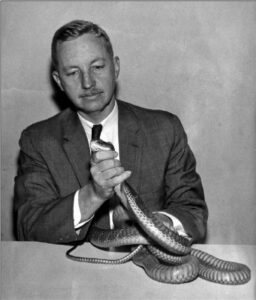
DANBURY, Connecticut — Western Connecticut State University will host an up-close look at the legacy of herpetologist Dr. Herndon Dowling, Jr., with the opening of the exhibit, “The Snake Doctor: The Herpetological Life Work of Herndon Dowling, Jr.,” at 5 p.m. on Thursday, Nov. 13, 2025. Presented by the university’s Student Veterans Organization, Department of Biology, Department of Art and the Ruth A. Haas Library/WCSU Archives, the exhibit will be unveiled in the Haas Library Atrium on the university’s Midtown campus, 181 White St. in Danbury. It is free and the public is invited. Register to attend at https://wcsutickets.regfox.com/herndon-dowling-presentation-.
Dowling was a systematic herpetologist with a primary interest in evolution. He attended the University of Alabama and graduated with a degree in biology in 1942. The same year, he joined the U.S. Marine Corps as a commissioned officer and graduated officer training school in 1943. In 1945, Dowling was stationed at Guadalcanal where his duties included interpreting aerial photographs of Okinawa Island, evaluating bomb sites, and eventually the collection of snake venom for the Navy. He received a citation for excellent service for his work interpreting aerial photographs and was sent to Tianjin to assist with the Japanese surrender in that region in 1945. Dowling requested an honorable discharge in 1946, to continue his education, though he remained in the Marine Corps Reserves until 1959.
Dowling subsequently pursued his Master of Science in Zoology at the University of Florida in Gainesville. His work there focused on the systematics of the Black Swamp Snake (Seminatrix pygea). He continued his studies at a doctoral program at the University of Michigan in the discipline of zoo-geography, with a focus on the systematics of the snake genus Elaphe in North America. Dowling completed his doctorate in 1951. He then went to teach at Haverford College in Pennsylvania for a year, followed by the University of Virginia’s Mountain Lake Biological Station, and eventually the University of Arkansas. Dowling taught general biology and general zoology, and he introduced vertebrate natural history as a field course into the curriculum.
His next role was as the Reptile Curator at the Bronx Zoo, a position Dowling held from 1960-67. During his time with the zoo, Dowling traveled and researched extensively, conducting field work in the Galapagos, Trinidad and Martinique. Concurrently, he also held positions at the American Museum of Natural History in a grant-funded capacity related to the generation of peer-reviewed herpetological publications (1965-73), as an adjunct professor at New York University (NYU) (1965-73), and at the University of Rhode Island (1964-76). NYU hired Dowling as an associate professor in 1973, and as a full professor in 1975, where he taught until his retirement in 1991. Dowling also started his own journal, in 1973, called “Herpetological Information Search Systems” (HISS). During his career, Dowling worked in many additional projects and positions in the field of herpetology, won over a half-dozen awards for his work, and authored more than 200 publications.
Shortly after his death in 2014, Dowling’s wife, Janann Jenner, gifted his life’s work to his former student, Dr. Theodora Pinou, Professor and former chair of WCSU’s Department of Biology.
“Herndon was a WWII veteran who survived battles in Japan, and went on to become an internationally recognized herpetologist with a focal interest in reptile morphology and evolution, specifically snakes,” Pinou said. “This exhibit highlights the invaluable research and scientific illustration material found in our collection, and celebrates a man’s professional legacy and sacrifice.”
Pinou continued, “Since 2025 is the Year of the Snake, it is fitting that we take this opportunity to share with the public my mentor’s collection that I have had the privilege of curating for the past 10 years. Mentorship is the only way to pay it forward, and it’s very validating that Herndon’s wife recognized that I would take care of the material. It’s an important part of WCSU’s graduate program now, and the students love these animals and the scientific illustrations. On every field research trip on which I take my students, I try to recreate the excitement that he and his wife Jan gave to me, so we’re paying Herndon’s legacy forward.”
Pinou also noted that it’s especially gratifying that WCSU’s Student Veterans Organization took an interest in the exhibit, acknowledging Herndon’s Marine Corps service and reliance on the GI Bill to fund his academic degrees upon his return from overseas.
Western Connecticut State University changes lives by providing all students with a high-quality education that fosters their growth as individuals, scholars, professionals, and leaders in a global society. Our vision: To be widely recognized as a premier public university with outstanding teachers and scholars who prepare students to contribute to the world in a meaningful way.